MENU
Close

Skip the road trip to Southern Europe

If you're exhibiting in Southern Europe, you're there to make an impression. Just not with your carbon footprint. Cannes and Barcelona are great places to show up. Less great to haul a full activation to. It's built where your production sits, far from the show. 

There's another way. By producing close to the show, with our trusted local partner, you win on several fronts: less CO₂, shorter travel time, and the freedom to act faster on site.

More than a partner

WoodBeeWork, based in the south of France, is more than our local partner: we took a share in the company. That's a deliberate step — when you build with them, you build with us. So the trusted Gielissen quality you'd expect doesn't stop at the border. It travels with you, south.

More than a partner

Your savings are on the highway

Whether it's a stand, a stage, or a full activation, your biggest impact often isn't the materials. It's the miles. Transport can account for half of a project's emissions, sometimes more. The farther you drive, the heavier that share weighs.

Your savings are on the highway

Proof over promises

A gut feeling doesn't cut CO₂. Numbers do. Eva, our sustainability officer, took one real project: a stand for a show in Barcelona. She built it twice on paper: once from Eindhoven, once locally in Perpignan, and put transport under the microscope. The result?

Building close to the show cut more than a third of the project's total emissions.

One project rock-solid numbers

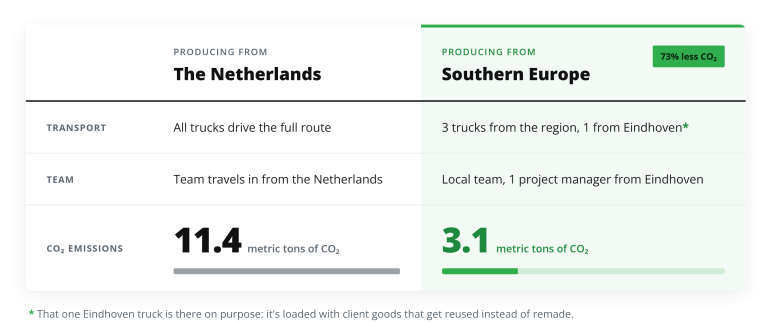
The same activation for a show in Barcelona. Built once in the Netherlands, and once at our local partner WoodBeeWork in the south of France. Here are the numbers:

From the Netherlands, transport costs 11.4 metric tons of CO₂. That's the equivalent of seven flights from Amsterdam to New York, or heating your home with natural gas for three years.

Build that same activation locally, and it drops to 3.1 metric tons of CO₂. That's 73% less — about as much as a household drives in a full year.

And because transport is nearly half the project, your entire project's emissions fall by 35.6%. One choice about where you build, and you cut more than a third of the impact.

Everything at a glance

What about the other half?

Transport is one half of the footprint. The other half comes down to materials: wood, plastics and fabrics. Where smarter reuse and circular thinking pay off. More and more agencies look critically not just at where they produce, but at what they build.

Norsk Hydro is a case in point: for their stand, the materials did the heavy lifting, from rental systems and furniture to QR codes instead of printed plastic.

What about the other half?

Curious about your numbers?

Every show and every activation is different. These figures come from our sustainability officer, Eva — and she'll happily run the same calculation for your project. Contact Marcel, he wil help you take the next step.

Curious about your numbers?